Vinted takes 0% from sellers. Depop takes 3.3% + $0.45. eBay takes 13.6% + $0.40. Poshmark takes 20%. On a $50 clothing sale you keep $50, $47.90, $42.80, and $40 respectively. List on all four if you sell mainstream fashion; price 5-10% lower on Vinted to capitalize on the fee gap.
Vinted charges sellers zero fees, and that is its standing model rather than a launch promotion. You list for free, sell for free, and keep every dollar. On a $50 clothing sale, that's $10 more in your pocket than Poshmark gives you, and several dollars more than eBay.
The Lithuanian marketplace grew into one of Europe's biggest resale apps before most American resellers noticed it. It started accepting US transactions, and in early 2026 it launched in New York to compete for US secondhand buyers.
If you sell on Poshmark or eBay, the fee gap is reason enough to look. Vinted's arrival also changes how the four platforms most US sellers use compare with each other.
Vinted in 60 Seconds
Vinted launched in Vilnius, Lithuania in 2008 and has grown fast in recent years, across much of Europe and into Canada. In late 2025 it enabled cross-border UK-US transactions, and in early 2026 it formally launched in New York. It is a large, established company, not a startup testing an idea.
Seller fees: zero. Buyer Protection fee: 5% + 0.70 euros, paid by the buyer. Active in Europe, Canada, and now the US. Most of its members are still in Europe.
Side-by-Side Fees: Vinted vs Poshmark vs Depop vs eBay
Vinted
Zero seller fees. No listing fee, no final value fee, no commission. The platform makes money from a Buyer Protection fee charged on the buyer's side: 5% + 0.70 euros for orders under 500 euros, 2% above. Optional seller-side promotions (Item Bump, Wardrobe Spotlight) cost a few dollars per use and are opt-in.
Poshmark
A flat 20% commission on sales of $15 or more. Sales under $15 trigger a flat $2.95 fee instead. No listing fees. Shipping is paid by the buyer via a flat-rate USPS label. This fee structure has been the same for years.
Depop
Depop eliminated its 10% seller commission in mid-2024 for US and UK sellers. What remains is a payment processing fee of 3.3% + $0.45 per transaction. Optional Boosted Listings cost an extra 8% on boosted sales in the US. eBay acquired Depop from Etsy in February 2026, so the fee structure may change.
eBay
On most apparel categories, eBay charges a final value fee of 13.6% of the total sale (item + shipping) plus a $0.40 per-order fee ($0.30 on orders of $10 or less). Payment processing is bundled into the final value fee. Promoted Listings (optional) add 2-15% on top, depending on the ad rate you set. Store subscribers see slightly reduced rates and free monthly listings.
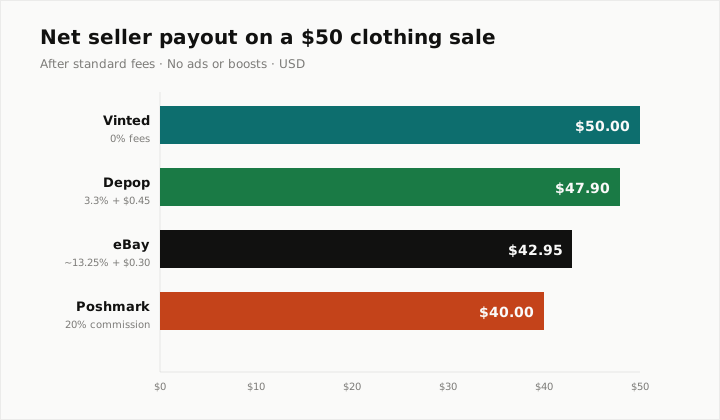
How much does each platform pay on a $50 clothing sale?
Vinted pays you $50.00 (zero fees). Depop pays $47.90 after the 3.3% + $0.45 processing fee. eBay pays $42.80 after the 13.6% + $0.40 final value fee. Poshmark pays $40.00 after the 20% commission. The Vinted-to-Poshmark gap is $10 per $50 sale. At 100 sales a month, that's $12,000 a year.
| Sale Price | Vinted | Depop | eBay | Poshmark |
|---|---|---|---|---|
| $25 | $25.00 | $23.73 | $21.20 | $20.00 |
| $50 | $50.00 | $47.90 | $42.80 | $40.00 |
| $100 | $100.00 | $96.25 | $86.00 | $80.00 |
Poshmark $25 row reflects the 20% commission ($5.00). Sales under $15 on Poshmark instead trigger a flat $2.95 fee.
Fees are only part of the picture. What sells, and how fast, differs by platform too.
Take 47 women's clothing items at an average $42 list price. Sell-through rates vary by platform, but assume 25% sell within 30 days at full price. Vinted nets you $493.50 (zero fees). Depop: $471.96. eBay: $429.85 (before any Promoted Listings spend). Poshmark: $394.80. The $98.70 difference between Vinted and Poshmark on this one batch could pay for a month of sourcing or an automation subscription, and it repeats with every batch you sell.
Who shops on Vinted vs Poshmark vs Depop vs eBay?
Each platform attracts a distinctly different buyer. Vinted skews European, value-conscious, and sustainability-minded. Poshmark is mostly American, brand-driven, and strongest in women's contemporary fashion. Depop is global, young and trend-driven. eBay is the broadest of the four, covering everything from $5 thrifted basics to $5,000 designer pieces, with buyers of every age.
- Poshmark buyers (mostly US adults) search by brand and condition. They want specific items: "Lululemon Align 25 NWT size 6." Contemporary and premium brands perform best.
- Depop buyers (mostly young, global) browse by look and style. Vintage, streetwear, and one-of-a-kind pieces dominate. Discovery is visual and social.
- Vinted buyers (broad age range, European-dominant but expanding to the US) prioritize value and mainstream brands like Zara, Nike, Adidas, H&M, and ASOS. Kids' clothing moves quickly.
- eBay buyers (every demographic) come for selection and search. They're comfortable with auctions and Buy-It-Now alike, and they expect fast shipping and detailed listings.
Vinted vs Poshmark on the same item
Vinted charges US sellers nothing; the buyer pays a protection fee on top. Poshmark takes 20% of any sale at $15 or more. On a $40 top you keep $40 on Vinted and $32 on Poshmark. Demand is where Poshmark fights back, because its buyers search by brand and pay more for contemporary labels, while Vinted buyers hunt for value on mainstream brands. List contemporary brands on Poshmark first, and put everyday brands and kids' clothes on Vinted, where the zero fee matters most on low prices.
Vinted in the US: Early Days, Big Ambitions
Vinted enabled cross-border UK-US transactions in late 2025 and held a high-profile New York launch event in early 2026. The US user base is small relative to Europe and the catalog is thinner, which limits how much you can sell there today. Vinted has grown in other markets largely by word of mouth, and a zero seller fee gives sellers a reason to recommend it, but how fast the US catches up is unknown.
Early sellers face less competition for buyer attention. Early Poshmark sellers built large closets before the platform got crowded, and Vinted US is at that early stage now. If US traffic grows, sellers who listed early will already have reviews, followers and sales history.
Where Each Platform Stands in 2026
Tired of delisting by hand? FLIPSAIL checks your stores for sales and removes sold items everywhere else, free on 2 marketplaces. Start free
Vinted is the one growing and expanding into new countries. Poshmark is the established US incumbent with a large registered user base, and the last major holdout at 20% commission. Depop is in transition under new eBay ownership, and its fees may move closer to eBay's over time. eBay still has the broadest reach, but it can cost the most of the four once you add promoted-listing spend. Across the board, seller fees are falling, which makes a 20% commission harder to justify.
Should You Add Vinted to Your Selling Strategy?
The answer depends mostly on what you sell.
Add Vinted Now If:
- You sell mainstream fashion brands (Zara, Nike, Adidas, H&M, ASOS, Mango) that align with Vinted's buyers.
- You sell kids' clothing or bundles, which move well on the platform.
- You're in Europe or Canada, where Vinted already has heavy buyer traffic.
- You're comfortable being early to a growing US marketplace where traffic is still building.
Wait and Watch If:
- Your inventory leans premium or luxury US brands (Lululemon, Anthropologie, Tory Burch) where Poshmark's buyer base is stronger.
- You sell primarily vintage, streetwear, or trend-driven pieces, which Depop's audience buys more readily.
- You're US-only and can't absorb the lower traffic that comes with a platform still building its American user base.
Why Cross-Listing All Four Beats Picking One
Each platform reaches a different buyer. Poshmark gives you its US brand shoppers at 20% commission. Depop adds a younger, global audience at about 3.3%. Vinted adds value shoppers at zero seller fees. eBay adds the broadest buyer pool of the four, at the highest variable cost. An item listed on only one platform never reaches the other three platforms' buyers.
The risk of cross-listing is overselling: a buyer purchases an item on Vinted while it's still listed on eBay. Cross-listing tools that check for sales and delist the other copies reduce that risk, and so does a daily manual check. For most sellers, the extra exposure is worth the occasional oversell.
Getting Started on Vinted: Practical Tips
- Start with your fastest-moving fashion inventory. List 20-30 items that align with what Vinted buyers want: mainstream brands, good condition, reasonable prices.
- Price 5-10% lower than your Poshmark price. You're keeping 100% on Vinted versus 80% on Poshmark, so you can undercut your own Poshmark price and still match your take-home.
- Ship quickly. Vinted buyers expect prompt shipping, and the platform tracks your dispatch time.
- Offer free shipping strategically. Buyers see the total cost; absorbing shipping on lower-priced items can lift conversion, and the zero-fee structure gives you margin room.
- Photograph well. Vinted's browse-heavy interface makes good photos especially important. Clean backgrounds, natural light, multiple angles.
- Build reviews early. A profile with a few good reviews looks much safer to buyers than an empty one.
To add Vinted next to the apps you already use, follow how to cross-list to Vinted. For fees, shipping and what US accounts can and cannot do, see Vinted US fees and how it works.
Frequently Asked Questions
Is Vinted better than eBay for selling clothes?
For clothing under $50, Vinted almost always pays more: zero seller fees vs eBay's ~13.6% + $0.40. For higher-priced or rarer items, eBay's broader buyer pool can sell them faster. In practice, list on both: Vinted captures the value-conscious mainstream buyer, eBay captures the searcher who knows exactly what they want.
Vinted vs Poshmark vs Depop vs eBay: who takes the smallest cut?
Vinted takes the smallest cut at 0% (the buyer pays a separate Buyer Protection fee). Depop is next at 3.3% + $0.45. eBay charges roughly 13.6% + $0.40 on apparel. Poshmark is the most expensive at 20% (or a flat $2.95 on sales under $15).
Does Poshmark really charge a flat $2.95 under $15?
Yes. Poshmark's fee structure is a flat $2.95 on every sale under $15, and a 20% commission on every sale of $15 and above. There is no listing fee. The flat fee makes very low-priced items expensive to sell: a $5 item nets you $2.05 after fees.
How much does Vinted take from a $100 sale?
Nothing. You keep the full $100. The buyer pays a separate Buyer Protection fee of 5% plus a fixed charge on their end, but that does not come out of your earnings.
Is Vinted good for selling luxury or premium brands?
Not as your primary channel. Vinted's buyer base skews toward value-conscious shoppers who want mainstream brands like Nike, Zara, and Adidas at fair prices. Premium US labels such as Lululemon, Tory Burch, or Anthropologie perform significantly better on Poshmark, where buyers search by brand and condition.
What happens if an item sells on Vinted and eBay at the same time?
An oversell occurs when two buyers purchase the same item simultaneously across platforms. Cross-listing tools with inventory sync reduce this by delisting an item everywhere else once they detect the sale. Detection runs on a schedule, so a short window remains. If you cross-list manually, check and delist sold items quickly.
How fast is Vinted growing in the US?
Vinted formally launched in the US in early 2026 after enabling cross-border UK-US transactions in late 2025. The company has grown quickly in Europe, but the US catalog and buyer base are still thin by comparison. Vinted has not said when it expects US traffic to catch up, so treat it as a growing side channel for now.