Poshmark is worth it in 2026, but not as your only platform. It still has the best buyer pool for women's fashion (Lululemon, Free People, Anthropologie) and the cheapest flat-rate shipping in reselling. Cross-list to at least one other marketplace, automate your daily sharing, and focus on women's contemporary brands. Skip it for menswear, home goods, or electronics.
"Poshmark is dead." If you've spent any time on r/poshmark, reseller Facebook groups, or YouTube comment sections in the past year, you've seen some version of this take, usually with a list of complaints: sales are down, the algorithm is broken, the fees are highway robbery, and leadership is gone.
People have been saying this since at least 2019, and sellers keep making money on Poshmark anyway, though fewer of them and with more effort than before. Whether 2026 is the year the skeptics are right, or just another round of frustration from sellers who haven't adapted, depends on what you sell and how.
The Case Against Poshmark
The 20% Fee Is the Highest in Reselling
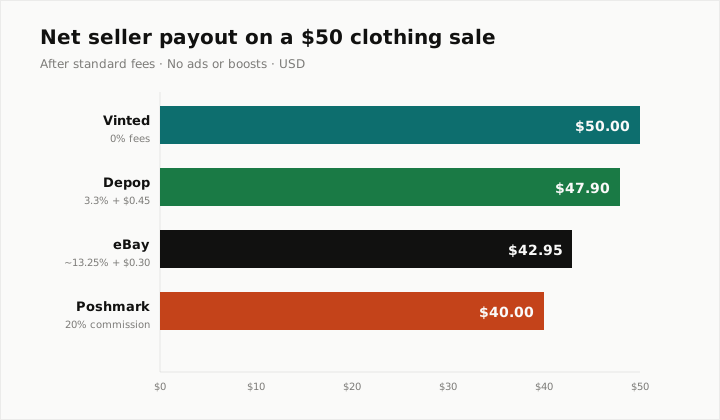
Poshmark takes a flat 20% commission on every sale over $15 (and a $2.95 flat fee on sales under $15). Competitors have gone the other way. Depop dropped to 0% seller commission in 2024, so you only pay payment processing (roughly 3.3% + $0.45). eBay charges around 13.6% plus $0.40 per order. Mercari sits at 10%.
On a $50 sale you keep about $47.90 on Depop, $45.00 on Mercari, roughly $43.08 on eBay, and $40.00 on Poshmark. Across 100 sales a month at that average, the difference between Depop and Poshmark is nearly $800, which for many sellers is a month's rent.
Leadership Turnover and the Naver Question
Naver acquired Poshmark for $1.2 billion in early 2023. Founder and CEO Manish Chandra stepped down in October 2025, handing the role to Naver's executive chairman Namsun Kim. For a platform built on Chandra's idea of social commerce, his exit mattered. Naver has said little about strategy since: there is no public roadmap and no clear statement of where Poshmark goes under new leadership.
Sellers who can't see where a platform is headed start hedging. They list less, buyers find less, and that feeds back into lower seller confidence.
The Algorithm Feels Broken
Starting around mid-2025, many established sellers reported large drops in visibility without changing anything they did. Poshmark has never explained how its algorithm works, which is its right, but secrecy combined with results that look random is what frustrates people. If you follow every piece of platform advice and sales still fall off a cliff, it feels rigged.
Category Stagnation
Poshmark's buyer pool remains heavily concentrated in women's fashion. If you sell menswear, home goods, electronics, or anything outside the core demo, the buyer traffic is thin and getting thinner as competitors offer better reach in those categories.
The Case For Poshmark
Still the Dominant Marketplace for Women's Fashion
Poshmark has over 80 million registered users, and its core buyers, women aged 25–45 shopping for contemporary and premium fashion, are still numerous and loyal. eBay has more users in total, but its fashion buyers are spread across a huge catalog, and Depop's audience is younger and smaller. For Lululemon, Free People or Anthropologie, Poshmark still has the most buyers.
Social Features Actually Create Opportunity
On eBay, search ranking decides almost everything. On Poshmark, sharing, parties, bundles and follows give active sellers a real visibility edge. The sharing grind is tedious, but a seller who does it daily gets seen more than one who doesn't. That rewards consistency over pure SEO, which helps smaller sellers who can't compete on ad budgets.
The Shipping Deal Is Hard to Beat
Poshmark's prepaid USPS Ground Advantage label at $6.49 for packages up to 5 pounds is one of the best shipping deals in reselling. Ship a 4-pound package yourself and you'll pay $10–15 depending on service and zone. On Poshmark there is one label at one price, with no weight calculations or zone charts to deal with.
On heavier items that shipping subsidy narrows the gap, putting Poshmark's effective cost nearer to eBay's ~13.6% than the raw 20% suggests.
Lower Barrier to Entry
eBay has a steeper learning curve, with promoted listings, store subscriptions, complicated shipping and defect metrics. Poshmark is simpler: list an item, share it, and ship it when it sells. A new seller can usually get a first sale sooner on Poshmark than on most other platforms. That also makes it a good place to find out whether reselling suits you.
What the Public Numbers Show
Most "is Poshmark worth it" articles are pure opinion. The public numbers help a little, with one caveat: third-party traffic estimates from tools like Semrush and Similarweb can differ a lot from a site's real analytics, so read them as rough direction.
Those estimates put Poshmark's monthly web traffic in early 2026 at more than double Depop's, with Poshmark's organic traffic up year over year. By raw traffic it is still the biggest US fashion resale marketplace, and not a platform in freefall. Growth looks different. Depop's US sales grew fast through 2025, while Poshmark's growth slowed sharply after 2021 and only picked up again in late 2025.
When Naver took Poshmark private in early 2023, the detailed public reporting stopped. The last standalone active-buyer count dates from 2022, and operating metrics now sit inside Naver's consolidated filings. Sellers who say nobody knows what is happening at Poshmark have a point.
US secondhand apparel kept growing through 2024, with online resale growing fastest, and Poshmark spent most of 2023 through mid-2025 growing more slowly than its own category. The late-2025 rebound looks real. It arrives as the main competitor gets bigger: in February 2026 eBay announced it would buy Depop, which brings Depop eBay's logistics, authentication and buyer base. Meanwhile the fee gap between Depop at roughly 4% total and Poshmark at 20% hasn't narrowed.
So Is It Worth It?
That depends on what you sell, how you sell it, and whether Poshmark is your only channel or one of several.
Poshmark Alone Is Risky
If Poshmark is your only platform, a single algorithm change, fee increase or policy shift can seriously cut your income. Single-platform sellers are the loudest voices calling it dead, because a big drop in sales is an emergency for them rather than an annoyance. Much of that is a problem with depending on one platform, more than a problem with Poshmark.
Poshmark as Part of a Multi-Platform Strategy Is Smart
Sellers who do well in 2026 mostly sell on several platforms: Poshmark for women's fashion and its social features, eBay for broader categories and search traffic, Depop for younger buyers and vintage, and Mercari for casual buyers and quick sales.
Cross-listing puts every item in front of more than one group of buyers. A $50 Lululemon top that sits for two months on Poshmark might sell in a week on Depop, or the reverse. A good cross-listing strategy removes the dependence on one platform and picks up demand wherever it appears.
Your Category Matters Enormously
Blanket statements about Poshmark fall apart by category, because results vary widely:
- Women's contemporary fashion (Lululemon, Free People, Anthropologie): Still strong. This is Poshmark's core, and its buyers are active and willing to pay.
- Women's luxury (Tory Burch, Coach, Kate Spade and up) does well, helped by Poshmark's authentication for higher-end items.
- NWT (New With Tags): Excellent. Poshmark buyers filter for new items and pay more for them.
- Vintage and Y2K is mixed. Depop's buyers are often a better fit, though Poshmark still moves some vintage at good prices.
- Home goods, electronics, general merchandise: Skip it. eBay and Mercari are stronger for non-fashion categories.
Tired of delisting by hand? FLIPSAIL checks your stores for sales and removes sold items everywhere else, free on 2 marketplaces. Start free
If most of your inventory is women's contemporary fashion, Poshmark is still one of your best channels. If it's a random mix, you're working against the platform.
What Sellers Making Money in 2026 Are Doing Differently
Sellers still doing well on Poshmark tend to share a few habits. None is new on its own, but together they add up to a different approach from the "list it and hope" method that worked in 2020.
Multi-Platform by Default
Every item goes on at least two platforms. Cross-listing tools keep that to maybe 2–3 extra minutes per listing, and in return items sell sooner and no single platform can sink you. Whichever platform you prefer, selling on only one of them in 2026 costs you sales.
Quality Over Quantity
Listing everything from a thrift run and hoping volume carries you no longer works well. Sellers doing well are pickier about sourcing and brands, set price points on purpose, and avoid tying up cash in inventory that sits. A smaller, well-chosen closet often sells better than a large pile of random finds.
Automation for the Grind
Sharing 300 listings twice a day by hand is a poor use of your time. Automation tools take on the repetitive work (sharing, relisting, community engagement) so your hours go to sourcing, photography, pricing and customer service, where your judgment matters.
Depending on a single platform is a bigger risk than any one platform's fees or algorithm. Sellers who were already on two or three marketplaces before Poshmark's rough 2025 felt it far less than those who weren't. If you haven't started cross-listing, start now.
2026 Marketplace Fees Side by Side
Fees come up in every Poshmark discussion, so this is how the major platforms compare right now:
- Depop: 0% seller commission + ~3.3% + $0.45 payment processing, so 4-5% total on most sales. Optional 12% Boost fee on boosted listings only (8% for boosts started before March 23, 2026).
- Mercari: 10% flat commission. Payment processing included.
- eBay: ~13.6% final value fee + $0.40 per order (raised February 2025). Varies by category. Store subscribers get lower rates.
- Poshmark: 20% flat commission on sales over $15. $2.95 flat fee on sales under $15. Includes prepaid shipping label.
Poshmark's fee is the highest by a wide margin. The included shipping label helps on heavier items without closing the gap, and on light items that would cost $4–5 to ship anyway, Poshmark still costs far more than Depop.
Worth Keeping, Not Worth Relying On
Poshmark in 2026 is recovering from a slow stretch rather than collapsing. Growth picked up in late 2025 after two years of trailing a growing secondhand market, and its traffic still leads US fashion resale. It has the largest pool of women's fashion buyers, a very good shipping deal, and social features that reward active sellers in a way other platforms don't.
The structural problems remain. The 20% fee is about 6 points above eBay, the next most expensive option, and 16 points above Depop. Since Naver took the company private, sellers have far less information than a public company used to provide. And eBay buying Depop is the biggest competitive change since the Naver acquisition.
As your only platform, Poshmark carries too much concentrated risk and too large a fee disadvantage. As one of several, it earns its place, since it is still one of the best fashion resale channels in the US. What matters more is whether you sell on more than one platform at all.
Frequently Asked Questions
How much does Poshmark actually take on a $50 sale?
On a $50 sale, Poshmark keeps $10 and you get $40. That compares to roughly $47.90 on Depop (payment processing only), $43.08 on eBay, and $45.00 on Mercari. Across 100 sales a month at that average, the gap between Poshmark and Depop alone is nearly $800.
Is Poshmark good for selling menswear in 2026?
Poshmark's buyer base skews heavily toward women aged 25–45, and menswear traffic has been thinning for years. Unless you are selling premium men's brands, eBay or Mercari will give you a larger pool of intent-driven buyers for that inventory.
Does sharing still matter for Poshmark visibility?
Yes. Sharing is one of the few things on Poshmark you control directly, and sellers who share consistently still do better than those who don't, even after the 2025 algorithm changes. Doing it by hand at scale (300+ listings twice a day) eats hours better spent sourcing and photographing, which is why many high-volume sellers use automation tools.
Who bought Poshmark and does it affect sellers?
Naver, a Korean tech conglomerate, acquired Poshmark for $1.2 billion in early 2023. Founder Manish Chandra stepped down in October 2025, replaced by Naver's executive chairman Namsun Kim. So far the practical effect is uncertainty: Naver has not published a clear strategic roadmap, and sellers have no visibility into whether major product or fee changes are coming.
What categories still sell well on Poshmark?
Women's contemporary brands such as Lululemon, Free People, Anthropologie and Madewell remain Poshmark's strongest category by a wide margin. NWT items and mid-to-premium accessories (Coach, Tory Burch, Kate Spade) also move well. Home goods, electronics, and general merchandise consistently underperform compared to eBay or Mercari for those same items.
How does Poshmark shipping compare to shipping on your own?
Poshmark's prepaid USPS Ground Advantage label covers packages up to 5 lbs for a flat $6.49 (as of September 2025). Shipping a 4-lb package independently typically runs $10–15 depending on carrier and destination zone. On heavier items that subsidy brings Poshmark's effective cost much closer to eBay's ~13.6% than the raw 20% figure suggests.