Sell vintage, streetwear, and Y2K on Depop, where Gen Z buyers pay up for them and fees are 3.3% + $0.45. Sell NWT contemporary brands (Lululemon, Madewell, Free People) on Poshmark, where 100 million buyers search by brand. Many sellers list on both, which puts each item in front of two audiences for little extra work.
Picture a vintage Levi's trucker jacket that sells on Depop in a few days and sits on Poshmark for months. A NWT Lululemon set often goes the other way: quick on Poshmark, ignored on Depop. The seller, photos and effort are the same in both cases, and the outcome depends on where the listing lives.
Neither platform is simply "better." They have different buyers and reward different products, so the useful question is which one suits which items.
The Buyers Are Fundamentally Different
Depop's Buyer
Mostly Gen Z; the bulk of Depop's users are under 26. They shop for vintage, one-of-a-kind pieces, streetwear, and whatever aesthetic is trending (coquette, quiet luxury, Y2K revival). They care about the look of your shop as much as the product, and they browse Explore the way they scroll Instagram, so discovery runs on aesthetics more than search.
Poshmark's Buyer
Older, mostly 25-45, and there are over 100 million registered users in the US and Canada. Poshmark buyers arrive knowing what they want and search for specific brands, sizes and conditions; "Lululemon Align 25 size 6 NWT" is a typical query. Your shop's aesthetic matters less to them than whether you have the Madewell jacket they're after at a fair price.
The Fee Structures Are Not Even Close
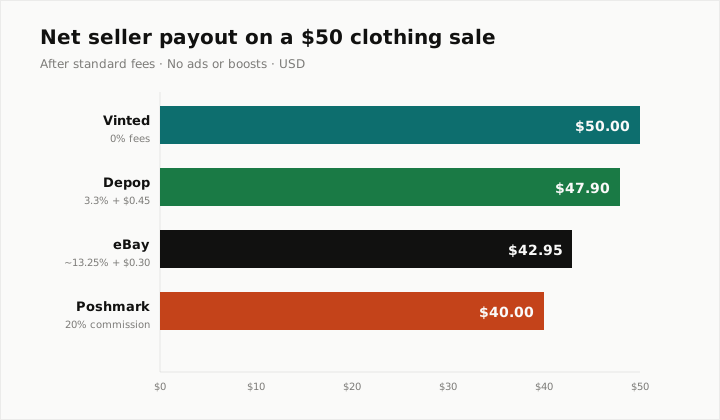
Poshmark charges a flat 20% on sales over $15 and a $2.95 flat fee under $15. Depop dropped its selling commission in 2024, so sellers now pay only a 3.3% + $0.45 payment processing fee. On a $50 sale, Poshmark takes $10 and Depop takes roughly $2.10. That gap is the main reason listing the same item on both can raise your margin: every sale that lands on Depop keeps more of the price.
On that $50 item you net roughly $48 on Depop versus $40 on Poshmark, about $8 per sale. Across 50 sales a month that's $400, or $4,800 over a year. Volume still matters, though. Poshmark's larger audience can produce more transactions, and ten $50 sales netting $400 beat five Depop sales netting $240 despite the higher commission.
What Sells on Each Platform
Depop tends to do better with vintage, Y2K, streetwear and pieces with a distinct look, since its Gen Z buyers will pay extra for something unusual. Poshmark tends to do better with NWT contemporary brands (Lululemon, Free People, Anthropologie), business-casual workwear, and anything with a recognizable label that buyers search for by name.
Depop Winners
- Vintage anything: 80s, 90s, Y2K. If it has a retro aesthetic, Depop is your market.
- Streetwear and sneakers: Nike dunks, vintage band tees, graphic hoodies.
- One-of-a-kind and reworked items: a cropped and bleached vintage flannel has an audience here it wouldn't find on Poshmark.
- Lower price points: Depop's younger audience shops more impulsively at $15-45.
Poshmark Winners
- Contemporary and premium brands: Lululemon, Free People, Anthropologie, Madewell, J.Crew. The Poshmark buyer searches by brand.
- Luxury and designer: Coach, Tory Burch, Kate Spade, and up. Poshmark's authentication service builds buyer confidence.
- NWT (New With Tags): Poshmark buyers heavily filter for new items. NWT commands a premium here that it doesn't on Depop.
- Higher price points: $50-200+ items sell more readily on Poshmark, where buyers are more willing to invest.
Tired of delisting by hand? FLIPSAIL checks your stores for sales and removes sold items everywhere else, free on 2 marketplaces. Start free
Why Most Serious Sellers End Up on Both
An item listed on only one platform never reaches the other platform's buyers.
- More people see each item. Poshmark reports around 100M users and Depop around 40M.
- Different items sell on different platforms. That vintage jacket collecting dust on Poshmark might move quickly on Depop.
- You're hedged against platform changes. If one platform raises fees or loses buyers, you aren't all-in on it.
- Cross-listing tools keep the extra work small: list once, push to both.
The main risk is overselling, where someone buys an item on Depop while it's still listed on Poshmark. Inventory sync tools remove the other listing after a sale, which keeps accidental oversells rare. For most sellers that small risk is worth the second audience.
Which One Should You Start With?
Match the platform to your inventory. Contemporary brands and NWT items belong on Poshmark; vintage, streetwear and one-of-a-kind pieces belong on Depop. If you sell a mix, start where your strongest inventory fits and add the second platform once the first one runs smoothly.
If you already sell on one of them, add the other. Anyone who already resells online will pick it up quickly, and in practice the answer to "Depop or Poshmark" is usually both.
Frequently Asked Questions
How much more do you actually keep on Depop versus Poshmark?
On a $50 sale, Depop's 3.3% + $0.45 processing fee leaves you with about $47.90, while Poshmark's 20% commission leaves you with $40. That $7.90 gap per sale adds up to roughly $395 across 50 sales, or close to $4,700 over a year at that volume.
Why does a vintage jacket sell faster on Depop than on Poshmark?
Most of Depop's users are under 26, and they browse for vintage, Y2K and streetwear the way they scroll a social feed. Poshmark's buyers skew 25-45 and search by brand and condition, so a vintage piece without a recognizable label gets far less attention there.
What happens if someone buys an item on both platforms at the same time when you cross-list?
This is called an oversell, and it does happen occasionally without inventory sync. Cross-listing tools that sync Depop and Poshmark cut the risk sharply. Once an item sells on one platform, it's delisted on the other at the next sale check (every 30 minutes on FLIPSAIL's paid plans, every 4 hours on the free plan).
Is Poshmark worth it given the 20% fee?
It depends on your inventory. For NWT contemporary brands like Lululemon or Free People, Poshmark's 100 million search-driven buyers generate enough sales volume that paying the 20% still produces more total revenue than a smaller audience at lower fees. For vintage and streetwear, the fee is hard to justify when Depop's audience is more likely to buy anyway.
Which platform should you start with if you're a new reseller?
Match the platform to your strongest inventory. If you're sourcing NWT or near-new contemporary brands, start on Poshmark where buyers search by brand and condition. If your inventory is vintage, streetwear, or trend-driven pieces, start on Depop. Once you have your first platform running smoothly, adding the second takes minimal extra effort.
Does Depop's Boost feature change the fee comparison?
Boost adds a 12% fee on sales from boosted listings (8% for boosts started before March 23, 2026), bringing Depop's effective take to around 16% on those items, which is still below Poshmark's flat 20%. Boost is opt-in, so you can cross-list on Depop at the base processing fee and only pay more if you actively choose to promote a specific listing.