Sharing bots are technically against Poshmark TOS but enforcement against conservative sharing is near-zero; community researchers found no documented permanent bans for sharing alone. From May 2025 to July 2026 the biggest risk was auto-relisting within 60 days (6-day suspensions), but Poshmark retired that policy on July 23, 2026. The main remaining risks are aggressive following and cloud bots on foreign IPs. Use a browser extension with randomized 5-15 second delays, stay under 4,000 self-shares/day, skip auto-following, run only during normal active hours.
For a 300-item closet, a daily sharing routine eats hours every week: tapping the same button, scrolling past the same listings, watching the same loading screens. A few months in, a lot of sellers find the repetition hard to keep up. That is usually when automation comes up, and when the details of how you set it up start to matter.
What Is a Poshmark Bot, Anyway?
A Poshmark bot is software that clicks the share button for you. Find share button, click it, wait, repeat. The name makes it sound fancier than it is.
The Three Types
Browser extensions are the most common. Install in Chrome, open Poshmark, and new automation buttons appear on the page. You can watch what's happening, it all runs inside your browser session, and most good ones cost $10-30/month.
Mobile apps are harder to find. Apple locks these down hard; Android has more options but quality is inconsistent. Many break after a Poshmark update and never get fixed. Verify the developer actively maintains their app before trusting it with your account.
Desktop software is the power-user choice: standalone programs with more features and a steeper learning curve, usually $30-60/month. It makes sense if you manage multiple closets.
What Poshmark Actually Says About Bots
Poshmark's Terms of Service prohibit bots. Section 9.2 bans "any robot, spider, scraper, or other automated means" to access the platform.
In practice, Poshmark has known about automation for years. Their detection systems flag obvious behavior: sharing 500 items in 5 minutes, following 300 accounts in an hour, sudden activity at 4 AM from an account that's never been online then.
Using a bot technically violates Poshmark's TOS. Enforcement is inconsistent, but accounts do get suspended.
Most sellers see the same pattern: conservative automation rarely triggers problems, and aggressive automation often does. Conservative means human-like speeds, random delays, normal hours, reasonable limits. Aggressive means maximum speed, fixed timing, 24/7 operation, pushing every boundary.
What Gets People Caught
Banned sellers tend to have done at least one of these:
- Sharing hundreds of items per minute (faster than any human could)
- Running automation overnight with no previous activity at those hours
- Aggressive follow/unfollow cycles (the #1 problem)
- Identical timing between every action
- Multiple sessions from different devices at once
A first offense usually gets you Poshmark share jail for a few hours. Keep going and suspensions get longer, and after that the account can be closed.
What the Actual Ban Data Shows
The risk picture is more mixed than most guides admit. Community ban reports from Reddit (r/poshmark, r/BehindTheClosetDoor), seller forums, and independent research through 2025 show several patterns that contradict the usual advice.
"I literally cannot find one person who was ONLY BANNED for sharing/following and no other reason at all." (Big Brand Wholesale, 2024.) ClosetAssistant, PosherVA and SuperPosher report the same: no documented permanent bans caused solely by sharing automation.
Risk By Behavior Type
- High-speed sharing (>4,000–10,000/day): Near-zero permanent bans documented. Almost all enforcement is temporary share jail, which is very likely once you exceed the limits.
- Aggressive automated following (10,000+/week) also shows near-zero permanent bans, but a real chance of follow jail.
- Cloud-based bots (foreign server IP): Elevated risk vs. browser extensions. IP mismatch is a documented detection trigger. Risk level: Medium-High.
- Automated offers to likers show near-zero risk across documented reports. Poshmark appears to tolerate them.
- Automated relisting within 60 days (May 2025 to July 2026): Was HIGH risk while the Excessive Listing Removal Policy was in force, with 6-day suspensions documented. Poshmark retired the policy on July 23, 2026, so delete-and-relist no longer breaks a specific listing rule.
- Using free scripts from forums: High detection risk, because low-quality scrapers are flagged far more easily than polished browser extensions.
Enforcement Event Timeline (2021–2026)
Knowing when enforcement changed helps you judge the current risk:
- July 2021: ClosetPilot issued an emergency warning after a Poshmark algorithm shift flagged automated following. It was a temporary detection change, not a lasting enforcement wave.
- 2022–2023: A stable gray zone. Automation was widespread and enforcement minimal, with no documented ban waves. Share jail was common but harmless.
- May 1, 2025: Major enforcement event. Poshmark launched and immediately enforced a policy banning "excessive" delisting and relisting within 60 days. Dozens of sellers were suspended within 24 hours, including crosslisters who deleted items sold on eBay. Some suspensions were retroactive.
- October 2025: Feed algorithm change. Sharing and following stopped driving "For You" feed placement and now only affect the "Just Shared" sort in Search, which reduced the incentive for aggressive automation.
- November 16, 2025: PoshSidekick incident. Hundreds of accounts using third-party tools were suspended and listings deleted. Poshmark's statement: "We are working on an issue affecting some sellers who use third-party services." Suspensions lifted within 24 hours.
- December 2025: Poshmark restored in-app Bulk Sharing after seller backlash. Policy environment remains more volatile than pre-2025.
- July 23, 2026: Poshmark retired the Excessive Listing Removal Policy in a seller webinar. Deleting and relisting no longer risks penalties. The Seller Cancellation Policy (a cancellation rate above 3% can restrict an account) still applies.
Details on the reversal, and the Seller Recognition criteria Poshmark announced alongside it, are in our Poshmark listing policy update.
Why Poshmark Is Unlikely to Mass-Ban Sharing Bots
Money explains a lot of the enforcement pattern. Bot users generate more shares, more sales, and more 20% commission revenue for Poshmark, so mass-banning automated sharers would cut into Poshmark's own revenue. That is the likely reason conservative sharing automation has survived years of TOS enforcement while remaining technically prohibited.
| Behavior | Permanent ban risk | Temporary jail risk | Documented enforcement |
|---|---|---|---|
| Self-sharing under 4,000/day with randomized delays | ~0% | Low | No documented permanent bans for this alone |
| Offers to likers (auto) | ~0% | Low | Tolerated |
| Aggressive following (10K+/week) | ~0% | High (follow jail) | Soft jail at 24 hrs, 100% recovery |
| High-speed sharing (>10K/day) | ~0% | 90%+ (share jail) | 24-hour share jail; recovery 100% |
| Cloud bots / foreign IP | Medium-High | Medium | IP mismatch is a documented detection trigger |
| Auto-relisting within 60 days | Low | Low (policy retired July 2026) | 6-day suspensions documented May 2025 to July 2026; rule no longer enforced |
| Free scripts from forums | Medium | High | Low-quality scrapers flagged readily |
From May 2025 to July 2026 the single biggest enforcement target was automated relisting, not sharing. Poshmark retired that policy on July 23, 2026.
Risky vs. Relatively Safe Automation
Safest: Sharing Your Own Items
Poshmark auto-sharing is the standard move. You're promoting your own listings to your own followers, with no interaction with other accounts. This is what most people automate, and problems are rare when it's set up well. Stay under 4,000 shares per day with 5-15 second delays and you're in safe territory.
Middle Ground: Community Sharing
Sharing from Posh Parties or other closets earns visibility and return shares. It also touches social features, which Poshmark monitors more closely. Cap party shares at 200-300 per party, and don't keep hitting the same seller's closet.
Danger Zone: Follow/Unfollow
This is where accounts get killed. Spammers mass-follow to gain followers and unfollow a week later, so Poshmark watches the pattern closely. Skip automated following entirely; good listings grow followers better anyway.
Offers to Likers
Some tools automate offers. Sending everyone 10% off leaves money on the table. Better tools vary the offer by listing age or like count, which is where automating offers pays off.
The Numbers Everyone Wants to Know
Poshmark doesn't publish rate limits. Sellers have worked them out by trial and error, often at the cost of a jailed account:
- Total daily shares: 6,000-8,000 max (including community shares)
- Self-shares: 3,000-5,000 per day is the usual target
- Follows: 300-400 max (lower is better)
- Offers: 50-100 per day
- Comments: Keep it natural and sparse
These are conservative figures, and some sellers go higher without issues. If you're new to automation, staying in these ranges lets you learn how your account responds before you push.
Looking Human
Real people don't share at exact 5-second intervals. They go 3 seconds, then 7, then 4, then 11 because something distracted them, and good bots randomize timing the same way. Real people also sleep. An account that's never been active at 3 AM suddenly sharing every night at 3 AM is a red flag.
Warning Signs
Your account tells you when you're pushing too hard:
- CAPTCHAs appearing when they didn't before
- Share button stops working temporarily (soft jail)
- Restrictions on following or commenting
- Emails from Poshmark about "unusual activity"
- Sudden visibility drop
If you see any of these, stop everything for at least 24 hours and restart much slower. Flagged accounts seem to get watched more closely afterward.
If Something Goes Wrong: Recovery Rates
Most suspensions are recoverable. This is what documented community reports show:
- Share jail: ~100% recovery. Wait 24 hours. Do not attempt to share during the restriction.
- Follow jail also clears on its own in practically every report. Wait 24 hours.
- First-time account warning: most accounts recover. Agree to TOS via Poshmark Support → "Reinstate Account"; expect it to take days.
- 6-day temp suspension (listing policy, May 2025 to July 2026, now retired): High but inconsistent recovery. Appeal to support. Policy enforcement was acknowledged as buggy; some suspensions for crosslisters were reversed.
- The Nov 2025 third-party tool suspensions were all lifted automatically by Poshmark within 24 hours.
- Permanent ban (fraud, counterfeit, harassment): recovery is uncommon. A formal appeal is required, with no guarantee.
Tired of delisting by hand? FLIPSAIL checks your stores for sales and removes sold items everywhere else, free on 2 marketplaces. Start free
What Sellers Experienced
Five documented seller accounts from 2024–2025, in their own words:
I got greedy. I set my poshmark follow bot settings to "Aggressive." I followed 10,000 people in a week. Poshmark soft-banned me. I couldn't like, share, or list for 24 hours. I lost a weekend of sales because I tried to cheat the system.
— Closo.co blog, Jan 2026 (personal account of follow-bot overuse)
Something absolutely insane happened this morning. I woke up to the excessive listing removal policy. The only problem is, I only sell on Poshmark and do not cross list… I also had 450 listings and now "posh stats" says I have 30. This is a failure of epic proportions on Poshmark's part.
— u/xerxesthefalcon, r/BehindTheClosetDoor, Nov 2025 (listing removal policy misfire)
[I] certainly didn't delist a mass amount of listings during that time. I have an email out to them right now asking for clarification.
— "Katie," Modern Retail, May 2025 (suspended for deleting 4 eBay-sold items on enforcement day)
Like, I literally cannot find one person who was ONLY BANNED for sharing/following and no other reason at all. So clearly, this really isn't the issue people are making it.
— Big Brand Wholesale, 2024 (after researching automation ban reports)
I just received a generic email from sidekick stating that they did not cause the listings removal. At this point, I don't even care about that. It's the fact that I cannot access my account in any way. The lack of response is ultimately what is making me want to completely cancel.
— Anonymous seller, Nov 2025 (PoshSidekick security incident)
None of these sellers lost an account permanently for conservative sharing automation. The follow-bot overuse ended in a 24-hour jail. The listing-removal suspensions came from a Poshmark policy enforcement failure, not from sharing. Permanent bans center on fraud and counterfeit items.
Picking a Tool That Won't Wreck Your Account
Must-Haves
Randomized delays are non-negotiable. If the tool shares at identical intervals every time, skip it, because that is the biggest detection risk. You also need adjustable speed controls (the developer's defaults might be too aggressive), scheduling options so automation runs only during normal hours, and daily activity caps to prevent accidental over-sharing.
Red Flags
Avoid anything promising "undetectable" automation. Nothing is undetectable, and a developer who claims otherwise doesn't understand how detection works. Avoid tools that store your Poshmark password on their servers. Be wary of cheap "unlimited" offers too: good tools cost money to build and maintain, and $5/month for unlimited everything means corners are cut somewhere.
The Investment
Plan on $15-30/month for a solid browser extension. Compare that with the time: 90 minutes of daily sharing is 45 hours a month, which at $15/hour is $675 of labor. A $30 tool that cuts sharing time by 60% saves $400+ of that time per month. Free tools exist but usually lack the safety features that matter.
Getting Started Without Getting Banned
The most common mistake is going full speed immediately. Your account has a behavioral history, and Poshmark knows your patterns, so a radical overnight change looks suspicious.
Week One
Start at half speed: if you eventually want to share 3,000 items daily, start with 1,500. Use longer delays (10-20 seconds) and share only during hours when you'd normally be active. This week is about making sure nothing breaks: watch for CAPTCHAs, verify the tool does what it claims, learn the interface.
Week Two and Beyond
If week one was clean, bump up to 60-70% of your target. Reduce delays slightly (8-15 seconds). Add a second sharing session if you only ran one. Gradually reach full speed over the following weeks. Morning shares (6-9 AM) and evening shares (7-10 PM) drive the most traffic, so schedule around those windows. At any sign of trouble, drop back to week one levels.
Ongoing
Check daily that things are running without errors. Keep doing some manual sharing too; it keeps you aware of platform changes and makes your activity less predictable. After any Poshmark update, verify everything still works before running automation at full speed.
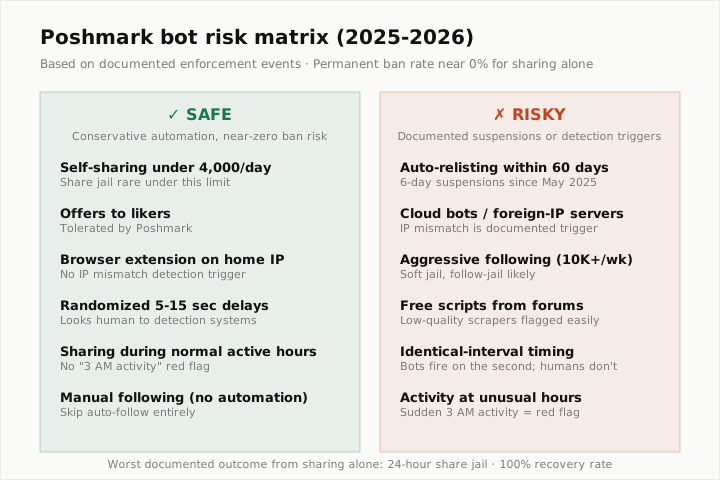
Sharing bots are technically prohibited by the TOS, but enforcement against conservative use is close to non-existent. With the relisting policy retired in July 2026, the main ban risks left are aggressive following and cloud bots on foreign IPs, not your browser-extension share schedule. Stay inside the safe column, start at half speed, and get back the hours you were spending on repetitive tapping.
Frequently Asked Questions
Are there bots on Poshmark?
Yes. Sharing automation is widespread across the Poshmark seller community despite being technically prohibited by Section 9.2 of the Terms of Service. The most common categories are browser extensions ($10-30/mo), desktop software ($30-60/mo), and a small number of mobile apps. Conservative use rarely triggers enforcement: community researchers tracking ban reports across 2024-2025 found no documented permanent bans caused by sharing automation alone.
What is a Poshmark scraper and is it different from a sharing bot?
A Poshmark scraper is software that extracts listing data (prices, sold history, competitor inventory), usually for research or repricing. A sharing bot clicks the share button on your own listings. They are different categories of tool. Scrapers carry higher detection risk because they make patterned data requests that bypass the normal user interface; sharing bots that operate inside your browser session look much more like a fast human.
How does Poshmark detect bots?
Poshmark watches behavioral patterns, not what software you have installed. It flags things like shares fired at identical intervals, sudden activity at hours your account has never been active, follow/unfollow spikes, and logins from server IPs that don't match your home location (the cloud-bot problem). A browser extension running from your home IP with randomized timing looks the same as a fast human to their detection systems.
Has anyone actually been permanently banned just for using a sharing bot?
Community researchers actively searching for this case have not found a single verified instance where sharing automation alone caused a permanent ban with no other violation present. Bot vendors (ClosetAssistant, PosherVA, SuperPosher) report the same. That is not a guarantee, but it counts for something. The permanent ban risk is real for fraud, counterfeit items, and harassment. For conservative sharing automation, the documented risk is temporary share jail, not account termination.
What are the actual ban risks in 2025–2026?
The two major enforcement events in 2025 were not about sharing bots. The May 2025 event targeted automated relisting within 60 days (6-day suspensions documented). The November 2025 PoshSidekick incident was a security event affecting third-party API access, and suspensions were lifted within 24 hours. Sharing bots were not the enforcement target in either case. Poshmark retired the relisting policy on July 23, 2026, so that risk is gone. That said, the policy environment is more volatile post-2025, so staying conservative still matters.
Is it safe to run a Poshmark bot overnight?
Only if your account has a history of being active at those hours. Running automation at 3 AM when you've never logged in at 3 AM before is one of the clearest signals Poshmark looks for. Stick to the hours you'd normally be online, and keep overnight sessions turned off until you have weeks of clean daytime automation behind you.
What is Poshmark share jail?
Share jail is a temporary restriction where your share button stops working, usually lasting 24 hours. It's Poshmark's rate limit rather than a punishment, and accounts come out of it in practically every reported case. If you hit share jail, stop all automation for at least 24 hours, then restart at a slower pace. Do not try to push through it.
How many shares per day is safe with a Poshmark bot?
For self-shares, the community consensus is 3,000–5,000 per day with 5–15 second randomized delays. For total daily shares (self plus community), most sellers see share jail start around 6,000–8,000. Conservative automation means staying well inside these numbers and letting your account's behavioral history guide where your ceiling actually is.
Does automation still work after Poshmark's October 2025 algorithm change?
Partially. The October 2025 feed change removed sharing as a driver for the "For You" feed, so sharing now only affects the "Just Shared" sort in Search. This reduced the ROI of aggressive high-volume sharing. Moderate, consistent sharing still drives visibility in "Just Shared" and can boost sales, but the era of sharing your way to the top of every feed is over.